

How to calculate the rated current of a distribution box?
Jul 22, 2025
Leave a message
Calculating the rated current of a distribution box is a crucial step in ensuring the safe and efficient operation of an electrical system. As a distribution box supplier, I understand the importance of accurate current calculations. In this blog post, I'll share with you the key steps and considerations for calculating the rated current of a distribution box.
Understanding the Basics of Rated Current
The rated current of a distribution box refers to the maximum current that the box can safely carry under normal operating conditions. It is determined by several factors, including the size and type of conductors, the capacity of the circuit breakers or fuses, and the ambient temperature. Exceeding the rated current can lead to overheating, which may cause damage to the electrical components, insulation failure, and even pose a fire hazard.
Step 1: Determine the Load Requirements
The first step in calculating the rated current of a distribution box is to determine the total load requirements of the electrical system. This involves identifying all the electrical devices and equipment that will be connected to the distribution box and determining their power consumption.
Calculate the Power of Individual Devices
For each electrical device, you can find its power rating on the nameplate or in the product manual. The power rating is usually given in watts (W) or kilowatts (kW). If the device has a variable power consumption, you may need to estimate the average power based on its typical usage.
For example, if you have a lighting fixture with a power rating of 60 W, a refrigerator with a power rating of 200 W, and a microwave oven with a power rating of 1000 W, the total power of these devices is 60 + 200 + 1000 = 1260 W.
Consider the Diversity Factor
In a real - world electrical system, not all devices will be operating at their maximum power simultaneously. The diversity factor takes this into account. It is a ratio that represents the actual maximum demand of a group of electrical devices compared to the sum of their individual maximum power ratings.
For a residential electrical system, the diversity factor can range from 0.5 to 0.8. For a commercial or industrial system, the diversity factor may vary depending on the nature of the load. For example, in an office building, the diversity factor for lighting may be around 0.6, while for computer equipment, it may be around 0.7.
Let's assume a diversity factor of 0.7 for our previous example. The adjusted total power is 1260 × 0.7 = 882 W.
Step 2: Convert Power to Current
Once you have determined the total power of the electrical load, you can convert it to current using the formula (I=\frac{P}{V}), where (I) is the current in amperes (A), (P) is the power in watts (W), and (V) is the voltage in volts (V).
In most residential and commercial electrical systems, the standard voltage is 120 V or 240 V. For a single - phase system with a voltage of 120 V, using our adjusted power of 882 W, the current is (I=\frac{882}{120}=7.35) A. For a 240 - V single - phase system, the current is (I=\frac{882}{240}=3.675) A.
In a three - phase system, the formula for calculating current is (I=\frac{P}{\sqrt{3}×V×PF}), where (PF) is the power factor. The power factor is a measure of how effectively electrical power is being used. It ranges from 0 to 1, with a value of 1 indicating that all the electrical power is being used for useful work.
For a three - phase system with a line - to - line voltage of 480 V and a power factor of 0.9, if the total power is 10000 W, the current is (I=\frac{10000}{\sqrt{3}×480×0.9}\approx13.2) A.
Step 3: Account for Future Expansion
When calculating the rated current of a distribution box, it's important to consider future expansion. You may need to add more electrical devices or equipment to the system in the future. A good practice is to add a margin of at least 20% to 30% to the calculated current to accommodate future growth.


If our calculated current is 10 A, adding a 20% margin, the new current value is (10×(1 + 0.2)=12) A.
Step 4: Select the Appropriate Distribution Box
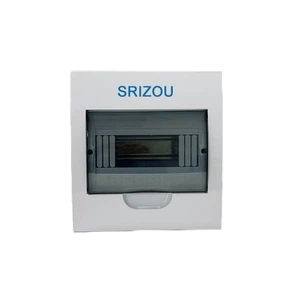
Based on the calculated rated current, you can select the appropriate distribution box. Distribution boxes come in different sizes and types, such as Waterproof Distribution Box and Plastic Distribution Box.
The rated current of the distribution box should be equal to or greater than the calculated current. You also need to consider other factors such as the number of circuits, the type of circuit protection (circuit breakers or fuses), and the installation environment.
Step 5: Check the Conductor Sizing
The conductors used in the distribution box must be sized appropriately to carry the rated current. The size of the conductor is determined by its cross - sectional area, which is usually measured in square millimeters ((mm^{2})) or American Wire Gauge (AWG).
You can refer to electrical codes and standards, such as the National Electrical Code (NEC) in the United States, to determine the appropriate conductor size for a given current. Using undersized conductors can lead to excessive voltage drop and overheating.
Step 6: Consider the Ambient Temperature
The ambient temperature can affect the performance of the distribution box and its components. High ambient temperatures can reduce the ampacity (current - carrying capacity) of the conductors and the efficiency of the circuit breakers or fuses.
If the distribution box is installed in a high - temperature environment, you may need to derate the rated current. Electrical codes provide derating factors based on the ambient temperature. For example, if the ambient temperature is above 30°C, the ampacity of the conductors may need to be reduced by a certain percentage.
Conclusion
Calculating the rated current of a distribution box is a complex but essential process. By following the steps outlined above, you can ensure that your distribution box is properly sized to handle the electrical load safely and efficiently.
As a distribution box supplier, we have a wide range of high - quality distribution boxes to meet your needs. Whether you need a waterproof distribution box for outdoor use or a plastic distribution box for indoor applications, we can provide you with the right solution.
If you are interested in our products or need more information on calculating the rated current of a distribution box, please feel free to contact us for procurement and further discussions. We are committed to providing you with professional advice and excellent service.
References
- National Electrical Code (NEC) Handbook
- Electrical Installation Design Guides
- Manufacturer's product manuals for electrical devices and distribution boxes
Send Inquiry