

How does the contactor's enclosure material affect its protection level?
Oct 28, 2025
Leave a message
Hey there! As a supplier of AC contactors, I've been getting a lot of questions lately about how the enclosure material of a contactor affects its protection level. So, I thought I'd write this blog post to shed some light on this important topic.
First off, let's talk about what protection level means in the context of contactors. The protection level of a contactor is basically a measure of how well it can withstand various environmental factors like dust, water, and mechanical impacts. It's usually indicated by an IP (Ingress Protection) code, which consists of two digits. The first digit represents the protection against solid objects, and the second digit represents the protection against liquids.
Now, let's dive into how the enclosure material plays a crucial role in determining this protection level.
Plastic Enclosures
Plastic is one of the most commonly used materials for contactor enclosures. It's lightweight, cost - effective, and easy to mold into different shapes.
One of the big advantages of plastic enclosures is that they can provide good protection against dust. Most plastic enclosures can achieve an IP rating of at least IP4X, which means they can protect against solid objects larger than 1mm. This is great for applications where there's a moderate amount of dust in the environment, like in some industrial workshops.
However, when it comes to water protection, it depends on the type of plastic and the design of the enclosure. Some well - designed plastic enclosures can offer IP54 or even IP65 ratings. IP54 means protection against dust ingress to a degree that it doesn't interfere with the operation of the contactor and protection against splashing water from any direction. IP65 offers even better protection, with complete protection against dust and protection against low - pressure water jets.
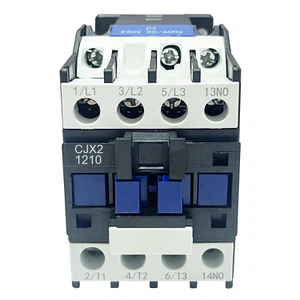
For example, our Cjx2 1810 Contactor comes with a high - quality plastic enclosure. It's designed to handle normal industrial environments where there might be some dust and occasional splashes of water.
But plastic enclosures do have their limitations. They're not as strong as some other materials, so they may not be suitable for applications where there's a high risk of mechanical impact. If a contactor with a plastic enclosure gets hit hard, the enclosure could crack, which would then compromise its protection level.
Metal Enclosures
Metal enclosures, on the other hand, are known for their strength and durability. They can provide excellent protection against mechanical impacts. You can expect a metal - enclosed contactor to withstand more rough handling and accidental bumps compared to a plastic - enclosed one.


In terms of dust protection, metal enclosures can also achieve high IP ratings. They can easily reach IP5X or higher, providing a high level of protection against dust particles.
When it comes to water protection, metal enclosures can be very effective. With proper sealing, they can achieve IP67 or even IP68 ratings. IP67 means complete protection against dust and protection against temporary immersion in water up to 1m for 30 minutes. IP68 offers protection against continuous immersion in water under specific conditions.
Our Cjx2 4011 is available with a metal enclosure option. This makes it a great choice for harsh industrial environments, such as outdoor installations near water sources or in areas with high levels of mechanical stress.
However, metal enclosures also have a few drawbacks. They're heavier than plastic enclosures, which can be a problem if weight is a concern in your application. They're also more expensive to manufacture, so the cost of a contactor with a metal enclosure will generally be higher.
Composite Enclosures
Composite materials are a combination of different materials, often designed to take advantage of the best properties of each component. For contactor enclosures, composite materials can offer a good balance between the strength of metal and the light weight and cost - effectiveness of plastic.
Composite enclosures can provide good protection against both dust and water. They can achieve IP ratings similar to well - designed plastic enclosures, but with better mechanical strength. They're also resistant to corrosion in many cases, which is a big plus for long - term use in harsh environments.
Our Cjx2 8011 can be equipped with a composite enclosure. This option is ideal for applications where you need a contactor that can handle a variety of environmental challenges without breaking the bank.
Choosing the Right Enclosure Material
So, how do you choose the right enclosure material for your contactor? Well, it all depends on your specific application.
If you're working in a relatively clean environment with low mechanical stress and cost is a major factor, a plastic - enclosed contactor might be the way to go. It'll give you decent protection at an affordable price.
On the other hand, if you're dealing with a harsh environment, such as an outdoor installation with high levels of dust, water, and mechanical impacts, a metal - enclosed contactor would be a better choice. It'll provide the highest level of protection, although it'll come at a higher cost.
If you need a balance between cost, weight, and protection, a composite - enclosed contactor could be your best bet.
Conclusion
In conclusion, the enclosure material of a contactor has a significant impact on its protection level. Whether it's plastic, metal, or composite, each material has its own set of advantages and disadvantages. As a supplier, we offer a range of contactors with different enclosure materials to meet the diverse needs of our customers.
If you're in the market for an AC contactor and need help choosing the right one for your application, don't hesitate to reach out. We're here to assist you in making the best decision for your project. Whether it's the protection level, the size, or the electrical specifications, we can provide you with all the information you need.
References
- Electrical Equipment Standards Handbook
- Industrial Contactor Design and Application Guide
Send Inquiry