

What is the rated current of a Littel Fuse Link?
May 28, 2025
Leave a message
The rated current of a Little Fuse Link is a fundamental parameter that plays a crucial role in electrical safety and circuit protection. As a supplier of Little Fuse Links, understanding this concept thoroughly is essential for providing the best products and guidance to our customers.
Understanding the Concept of Rated Current
The rated current of a fuse link is the maximum continuous current that the fuse can carry without opening under specified conditions. It is a carefully determined value based on the fuse's design, materials, and construction. When the current flowing through the fuse exceeds its rated current, the fuse will heat up. If the over - current condition persists for a sufficient period, the fuse element will melt, interrupting the circuit and protecting the electrical equipment connected to it.


For example, if a Little Fuse Link has a rated current of 5 amps, it can safely carry a continuous current of up to 5 amps without tripping. However, if the current rises above this value, say to 7 amps, the fuse will start to heat up. The time it takes for the fuse to blow depends on the magnitude of the over - current. A small over - current may take minutes or even hours to cause the fuse to open, while a large over - current, such as a short - circuit, can cause the fuse to blow almost instantaneously.
Factors Affecting the Rated Current
Several factors influence the rated current of a Little Fuse Link. One of the primary factors is the material of the fuse element. Different materials have different melting points and electrical resistivities. For instance, a fuse element made of copper has a different current - carrying capacity compared to one made of silver. Copper is a common choice due to its relatively low cost and good electrical conductivity. Silver, on the other hand, has even better conductivity but is more expensive.
The cross - sectional area of the fuse element also plays a significant role. A larger cross - sectional area allows more current to flow through the fuse without excessive heating. This is because the resistance of a conductor is inversely proportional to its cross - sectional area. So, a fuse with a thicker element can typically handle a higher rated current.
The ambient temperature is another important factor. As the temperature around the fuse increases, the resistance of the fuse element also increases. This means that the fuse will heat up more quickly for a given current. Therefore, in high - temperature environments, the effective rated current of the fuse may be lower than its rated value at room temperature.
Importance of Correctly Selecting the Rated Current
Selecting the correct rated current for a Little Fuse Link is of utmost importance. If the rated current is too low, the fuse will blow frequently, even under normal operating conditions. This can lead to unnecessary downtime and inconvenience. For example, in a household electrical circuit, if a fuse with a very low rated current is installed, it may blow every time multiple electrical appliances are used simultaneously, even though the total current is within the safe operating limit of the circuit.
On the other hand, if the rated current is too high, the fuse may not blow when there is an over - current condition. This can pose a serious safety hazard, as the electrical equipment may be damaged due to excessive current, and there is a risk of fire. In industrial settings, where large amounts of power are involved, an incorrectly rated fuse can lead to significant damage to expensive machinery and even endanger the lives of workers.
Applications and Rated Current Selection
In different applications, the rated current of the Little Fuse Link needs to be carefully selected according to the specific requirements.
Household Electrical Systems
In household electrical systems, the rated current of fuses is typically in the range of a few amps to tens of amps. For example, in a lighting circuit, a fuse with a rated current of 5 - 10 amps may be sufficient. This is because the power consumption of light bulbs is relatively low. In a circuit for powering larger appliances such as refrigerators or air conditioners, a fuse with a higher rated current, say 15 - 20 amps, may be required.
Automotive Applications
In automotive applications, the rated current of fuses varies widely. Blade Fuse Holders are commonly used in cars. For circuits powering small electrical components such as dashboard lights or radio, fuses with a rated current of 2 - 5 amps may be used. For larger components like the starter motor or the windshield wiper motor, fuses with a higher rated current, up to 30 amps or more, may be required.
Industrial Applications
In industrial settings, the rated current of fuses can be very high. For large motors, fuses with rated currents in the hundreds or even thousands of amps may be used. These fuses are designed to protect the motors from over - current conditions that can occur during start - up or due to faults in the motor windings.
Our Product Range and Rated Current Options
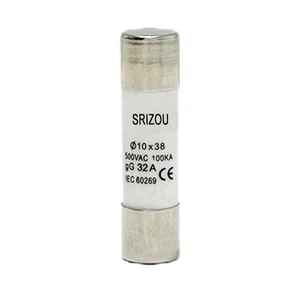
As a supplier of Little Fuse Links, we offer a wide range of products with different rated currents to meet the diverse needs of our customers. Our Dc Fuse Link products are available in various rated currents, suitable for different DC circuits. Whether it is a low - power DC circuit in a small electronic device or a high - power DC circuit in an industrial power supply, we have the right fuse link for you.
We also provide Mini Fuse Holder RT18 which can accommodate fuse links with different rated currents. These mini fuse holders are compact and suitable for applications where space is limited, such as in portable electronic devices or small control panels.
Conclusion
The rated current of a Little Fuse Link is a critical parameter that needs to be carefully considered in any electrical circuit. By understanding the factors that affect the rated current and correctly selecting the appropriate fuse link for a given application, we can ensure the safety and reliable operation of electrical systems.
If you are in need of high - quality Little Fuse Links and are unsure about which rated current is suitable for your application, our team of experts is here to help. We can provide you with detailed technical advice and guidance to ensure that you make the right choice. Contact us today to start a procurement discussion and find the perfect fuse solution for your needs.
References
- Electrical Engineering Handbook, CRC Press
- Fuse Technology and Application Guide, Various Industry Publications
Send Inquiry